
Director of Communications, Joëlle McNichol describes the process of distilling the voice of a school looking ahead. The story of the messaging, the prospectus and the film behind The Brooksbank School's 2025 open evening.
Brooksbank had already done the hard part by the time we started this piece of work. Ofsted had called it ‘a school transformed’, results were breaking records for the second year running, and morale among staff and students was the best it had been in a long time. Emily Fewtrell, the school's communications manager, had spent 18 months tirelessly putting real stories in front of families, with students succeeding in sport and the arts and the classroom, a well-read newsletter, and a steady presence in the local press. It was paying off in what families were saying about the school.
What Brooksbank needed was a way of describing itself beyond ‘bouncing back’, something confident and grounded enough to hold for years rather than a season. Improvement is by nature a story about where you have come from, and the school needed one about where it was now and where it is going, and to say it in a way that sounded like the people who work there. This was the second stage of brand development at the school, following a refresh of the very dated logo and colour scheme two years earlier. It was not a rebrand, but a strengthening of the school’s distinctive self image.
“Every school has a unique character, built from its history, its place and the people in it. Digging down until you find it and a way to show it is the best part of this job, and it is the point where the work goes beyond marketing and starts being a school understanding itself.”
Starting with what was already true
We sat down with Darren Atkinson, the headteacher, Dave Hewitt, the executive headteacher who had been instrumental in the school's turnaround, along with Emily Fewtrell, Nicola Davies, the school business manager, and with Damian Ball and Jamie Cooper, senior staff working closely with the school’s student leaders. We talked about how they saw Brooksbank, what parents and students were saying, what came up in Facebook comments, and how they wanted people to think about the school.
Three things we knew. Brooksbank has been in Elland for more than three hundred years and generations of the same families have walked through its doors; the community connection is deep. It also has a serious sporting history, having been a specialist sports college, with facilities the local community hires and alumni who have gone on to Commonwealth Games medals and international teams, so the sporting reputation is something people locally already know. And the people who lead the school are direct, down to earth and very Yorkshire, with nothing pretentious about how any of them speak. Dave Hewitt in particular is a brilliant communicator with no interest in polish for its own sake, and any voice we developed had to sound like that or nobody inside the school would have believed a word of it.
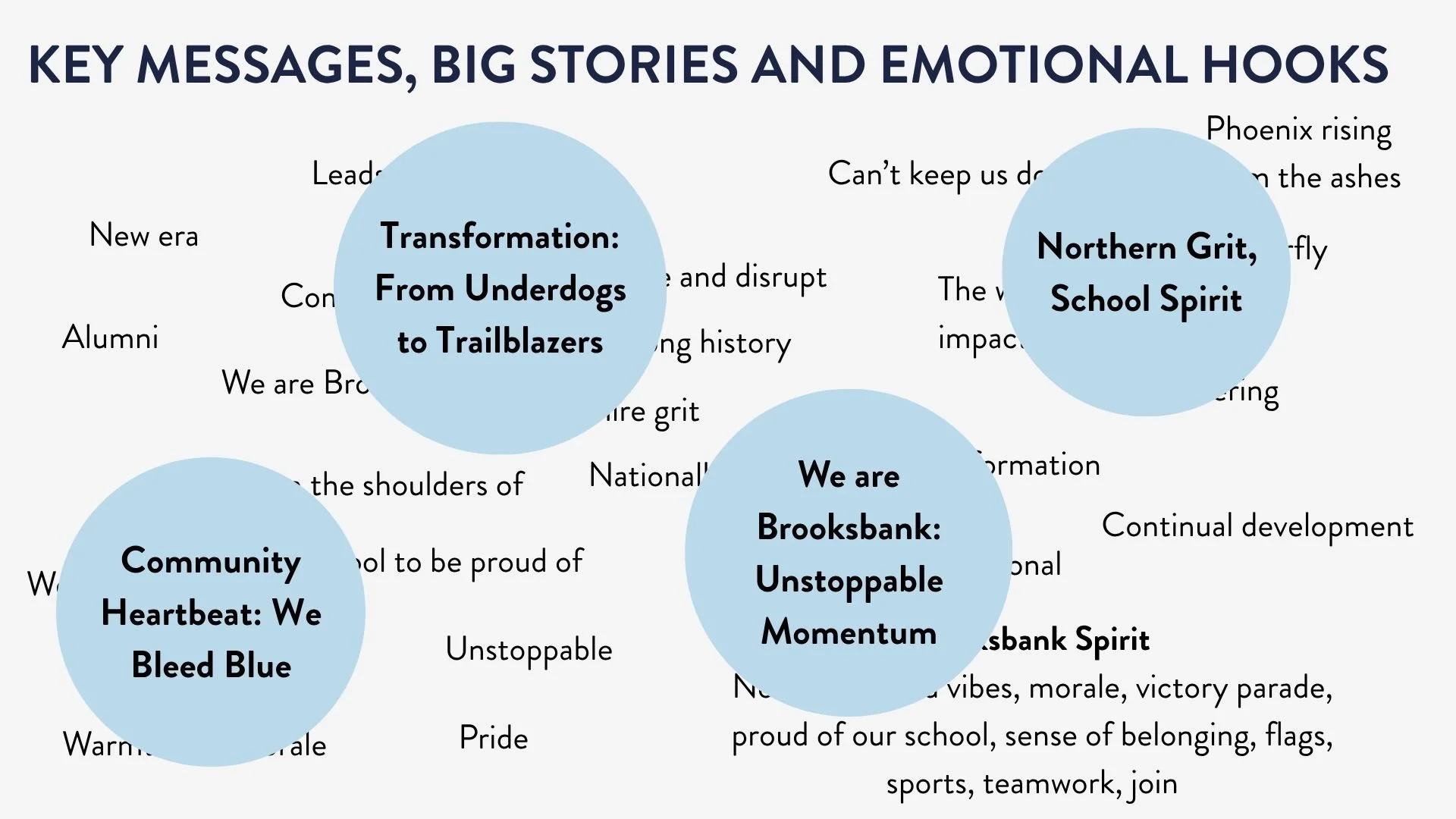
A slide of early ideas drawn from our initial conversations, from a presentation to school leaders
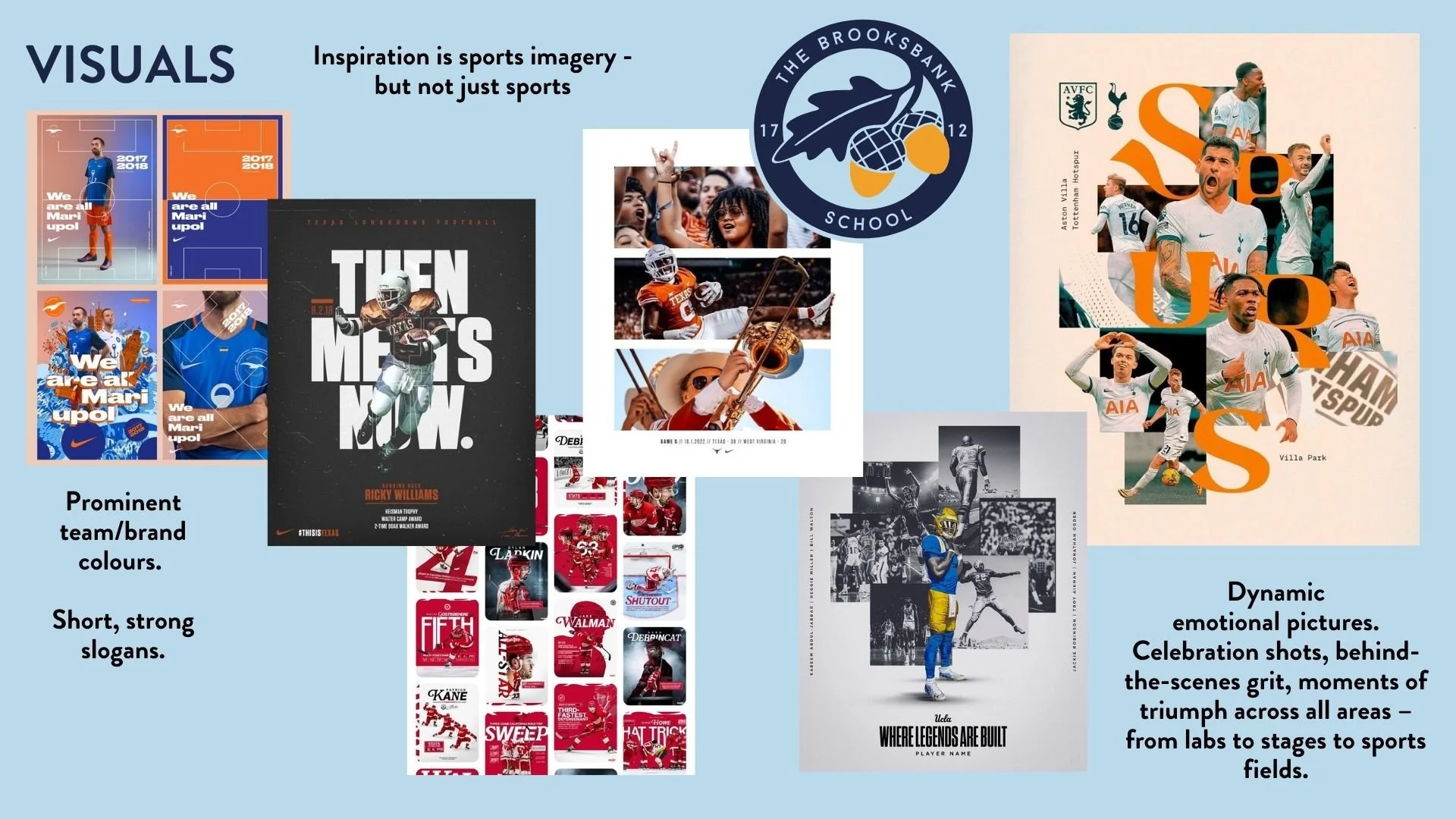
A slide of visual inspiration behind the ‘Team Brooksbank’ concept
Two routes, one decision
We went away, distilled all of that down, and came back to the same group with two concepts.
Team Brooksbank took the feeling of being part of a winning side and applied it to a school, with bold colours, celebration imagery, and the idea that you do not just attend Brooksbank, you join it. A school Yorkshire can be proud of went at it from another angle, northern by nature and national by standard, down to earth but uncompromising on standards, with students photographed against dramatic Yorkshire landscapes and northern cities.
They liked both, and chose Team Brooksbank because it felt more distinctive and because staff could get behind it on the night of an open evening in a way a photographic concept could not. We had been talking about a match day atmosphere, but for education, and you could see that being taken up by curriculum areas around the school.
The other concept was far from wasted, because it shaped the tone of voice, it gave us the reference that inspired the film, and its fingerprints are all over the final script.
“We bleed blue”
The phrase that anchored the whole thing came out of a conversation with the school business manager, describing that ‘once a Brooksbank student always a Brooksbank student’ feeling. We did not invent it, we noticed it.
The prospectus built out from there, opening with the head talking about a blue thread running through everything, then working through the things families most want to know: results, community, opportunity and pastoral care - that their child will be cared for, will succeed, and will enjoy the experience of high school. We wrote it in the school's own voice, direct and warm rather than formal, and gave each spread a bold graphic treatment with headlines big enough to carry the message on their own, so the feeling is conveyed on a ‘flick through’. The spreads worked well enough as posters that the school put them up around the building.

Graphic pages from the prospectus. This one is about the building momentum of the school, and the inclusive ‘Team Brooksbank’ spirit.
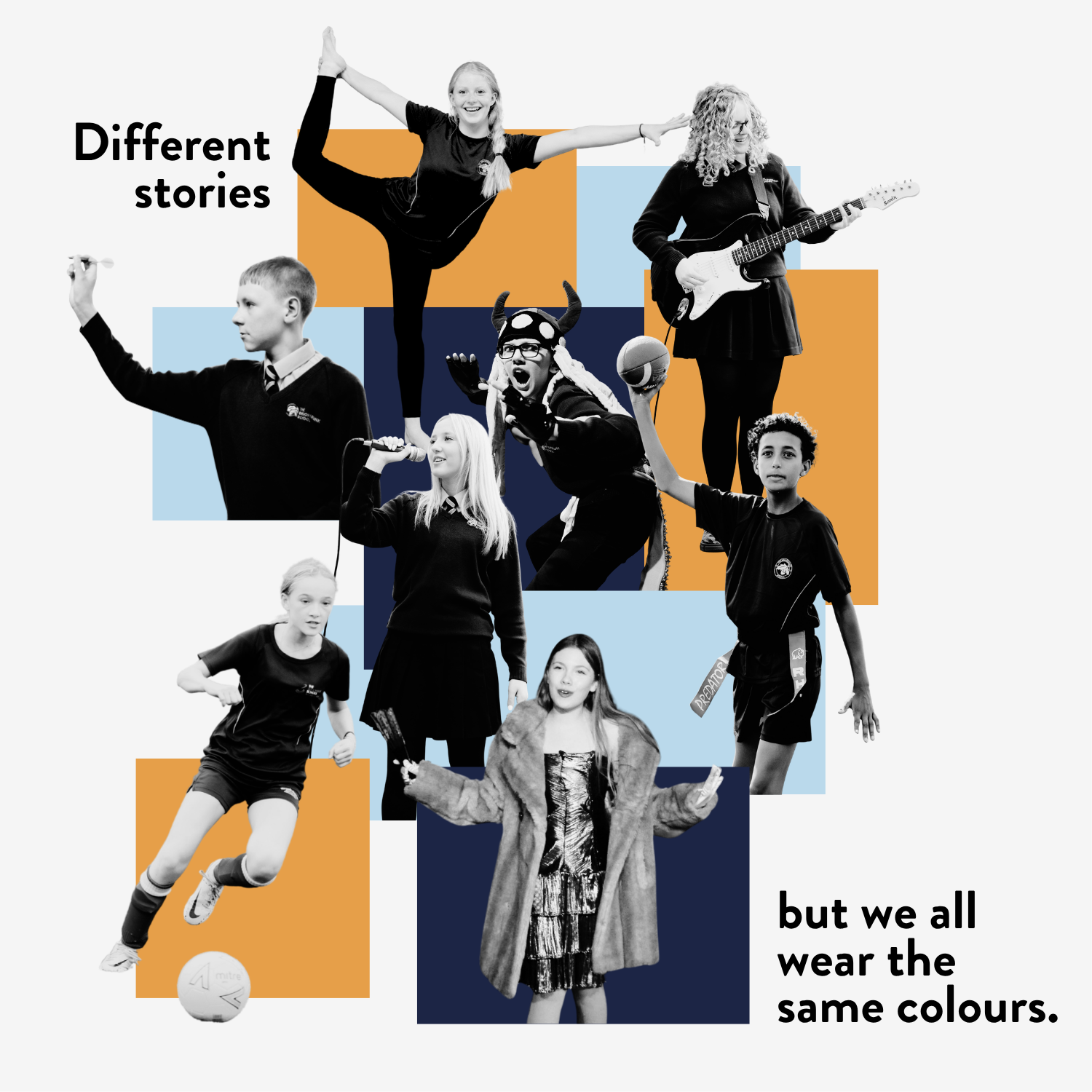
This is about diversity, opportunity and unity. Some of these also became posters around the school.
For the film we took our cue from a spoken word piece about Manchester, all pride and grit and no gloss, which had exactly the quality we were after. We wrote something in that register, workshopped it with two students, and they performed it. We shot the whole of Year 7 cheering from a drone, then cut that together with sports day footage of students roaring each other on and archive clips of the school's history. We made sure the team spirit idea covered science labs and drama rooms as well as pitches, because that competitive enjoyment is not only about sport.
What a school gets out of it
School leaders are right to ask why this kind of work is worthwhile, and the answer has two halves.
The first is practical. Brooksbank has a professional creative team it can call on centrally, in house, at no cost to the school beyond printing the prospectus and a small budget for open evening adverts. Brand development on this scale would run to thousands with an agency, and it would come with the extra job of managing one: briefing people who do not know your school, explaining your community, correcting things that have missed the mark. Because we already know Brooksbank, its leaders shaped the direction and signed it off, and we did the rest.
The second half is harder to put a number on. Brooksbank's results improved because the school improved, and no prospectus does that. But families need to know it has happened and to feel something about it, and that does not take care of itself. Schools have upped their game in marketing, the local birth rate is falling, and budgets are tight, so healthy student numbers matter more than ever. 241 families made Brooksbank their first preference in applications for September 2026, the highest since before the school's 2022 inspection, and enough to fill Year 7 with families who chose Brooksbank. Two years earlier, around 45 students arrived having named another school first.
The effect I find most interesting is the internal one. There is not much in a headteacher's week that invites them to step back and ask what their school is really for and what it is becoming, and this work does exactly that. The process is distilling, not inventing, and what comes out is a narrative about the school that staff and students recognise and feel proud to be part of. Afterwards the school knows what its key messages are and what its voice sounds like, it guides everything that follows to feel consistent, which builds confidence inside the building as much as beyond it.
That pride only holds if it is earned. Staff and students see this material too, and if it does not ring true it does harm rather than good. What came back from Brooksbank after the open evening was that it sounded like them, and that they felt good watching it, which is the only real test of whether work like this has landed.